Fences
Perimeter fencing built in sections, set post to post.
Residential and commercial metal fencing that follows the ground it is on and matches the gate in the line — because a fence and its gate looking like two different jobs is the most common way this work goes wrong.
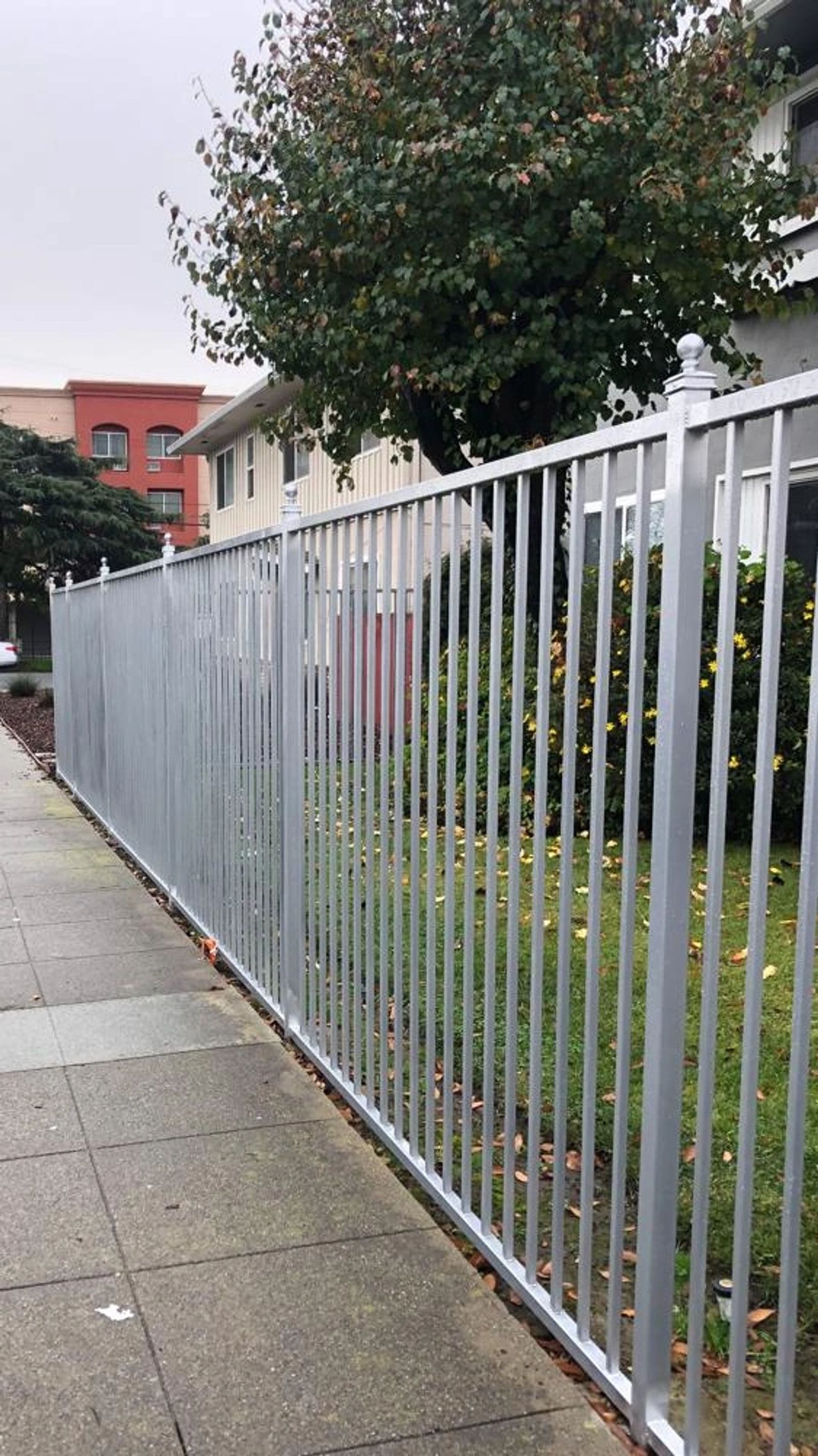
- Built
- In panelsFabricated in the shop, set on site.
- Slopes
- Racked or steppedChosen for the run.
- Estimate
- FreePhotos plus a rough run length.
- Coverage
- Serving the East BayHayward and the East Bay.
What we build
Residential perimeter fencing along a front yard, a side property line or a rear boundary; commercial and industrial yard fencing; and the short runs of fence panel that flank a driveway gate and make an entrance read as one piece of work.
Fencing is fabricated in panels in the Hayward shop and set post to post on site. That is what keeps a long run consistent — every panel comes out of the same jig, so picket spacing does not drift over a hundred feet the way it does when a fence is built stick by stick in the field.
Posts and footings decide everything
A metal fence is a row of posts with infill between them. If the posts are right, the fence lasts decades. If they are shallow, undersized, or set in soil that moves, the fence leans — and a leaning fence cannot be straightened, only rebuilt.
Post spacing, post section and footing depth get set against the actual conditions: panel weight, height, wind exposure and what the soil is doing. Expansive clay, a slope, or a run along the top of a retaining wall each change the answer.
- Post section and spacing sized to panel height and wind exposure.
- Footings dug to the depth the soil and height require, not a default.
- Runs set to a string line so the fence reads straight from the street.
- Terminal, corner and gate posts upsized — those carry the loads.
Following the ground: racked vs. stepped
On a sloped run, a fence either follows the grade or steps down it. Racked panels are built to be parallel to the slope with the pickets left vertical, so the fence hugs the ground with no gap beneath — the right answer when the fence has to contain a dog or a child.
Stepped panels stay level and drop at each post, which looks more formal and suits a masonry-and-metal boundary. The trade-off is the wedge of open ground under each panel, which either gets closed with a kick plate or accepted.
Residential character, commercial function
A residential fence is a facade element — it is part of how the house presents to the street, so picket profile, top detail, spacing and finish colour all matter, and they are worth spending on.
A commercial yard fence has a different job. Height, spacing tight enough to defeat reach-through, no horizontal members on the outside face for someone to climb, and a finish that survives being ignored. Both are fences; almost nothing else about them is the same.
Match the gate at the same time
The cheapest moment to make a gate match its fence is while both are being designed. Ordering the fence now and the gate next year almost always means the gate reads as an add-on, because the picket stock and finish batch will not be identical. If a gate is coming, tell us at the estimate and we will plan the run around it.
How the estimate works
Send photos along the run — one from each end and one of anything unusual, like a slope, a retaining wall or a tree in the line — plus a rough length in feet, pacing it out is fine. Fence pricing scales with length, height and post count, so those three numbers give a real range quickly.
Anything on a slope, near a boundary, or on top of a wall gets a site visit before a final number.
Projects
Fences we’ve built.
Photographed on completed jobs. Measurements and pricing come at the estimate, on your own opening.
Fences
What people ask before booking.
How do you handle a fence line that runs up a slope?
Two ways, and they look completely different. Racked fencing follows the ground — the rails run parallel to the slope and the pickets stay vertical, so there is no gap underneath. Stepped fencing keeps every panel level and steps down at each post, which reads as more formal but leaves a triangular gap under each panel that has to be closed off if you have a dog. Which one suits depends on how steep the run is and what you need the fence to contain.
Who is responsible for the property line?
You are, and it matters more than people expect. We build where you tell us to build. If a fence goes in a few inches over a line, that becomes a neighbour conversation and sometimes a legal one, and no amount of good welding fixes it. For anything close to a boundary, we will say plainly that the line should be confirmed — from a survey, or at minimum a documented agreement with the neighbour — before posts go in concrete.
What height can I build to?
Height limits for residential fencing are set by your city, and they typically differ between a front yard and a rear or side yard, with a lower limit near a street corner for sightlines. There is no single number that is true across the East Bay. We build to what you are permitted to build; ask your planning department for the limit that applies to your parcel, and we will design to it.
Galvanized, powder coat, or paint?
For a fence, galvanizing is usually the best value over its life — it protects the steel from the inside of the section outward, and it is the finish that survives being nobody's priority to maintain. Powder coat over a galvanized base is the durable choice when colour matters. Straight paint is the cheapest up front and the one that needs attention soonest, which on a long fence run is a lot of surface area to keep after. See the materials and finishes page for the honest comparison.
Free estimate
Send photos along the fence line.
Both ends, anything unusual in between, and a rough length. That's enough for a real range on the phone.
Licensed, bonded and insured — CSLB #1037852. Free estimates, no obligation.
Based in Hayward. Serving the East Bay. Not sure if it’s something we do? See the full list of services, or book a consultation.