Stair railings
Stair railings raked to the stair you actually have.
Interior and exterior stair rails measured on the stringer, welded to follow the real rise and run, and finished for where they live — plain, patterned, or with a wood cap on a steel frame.
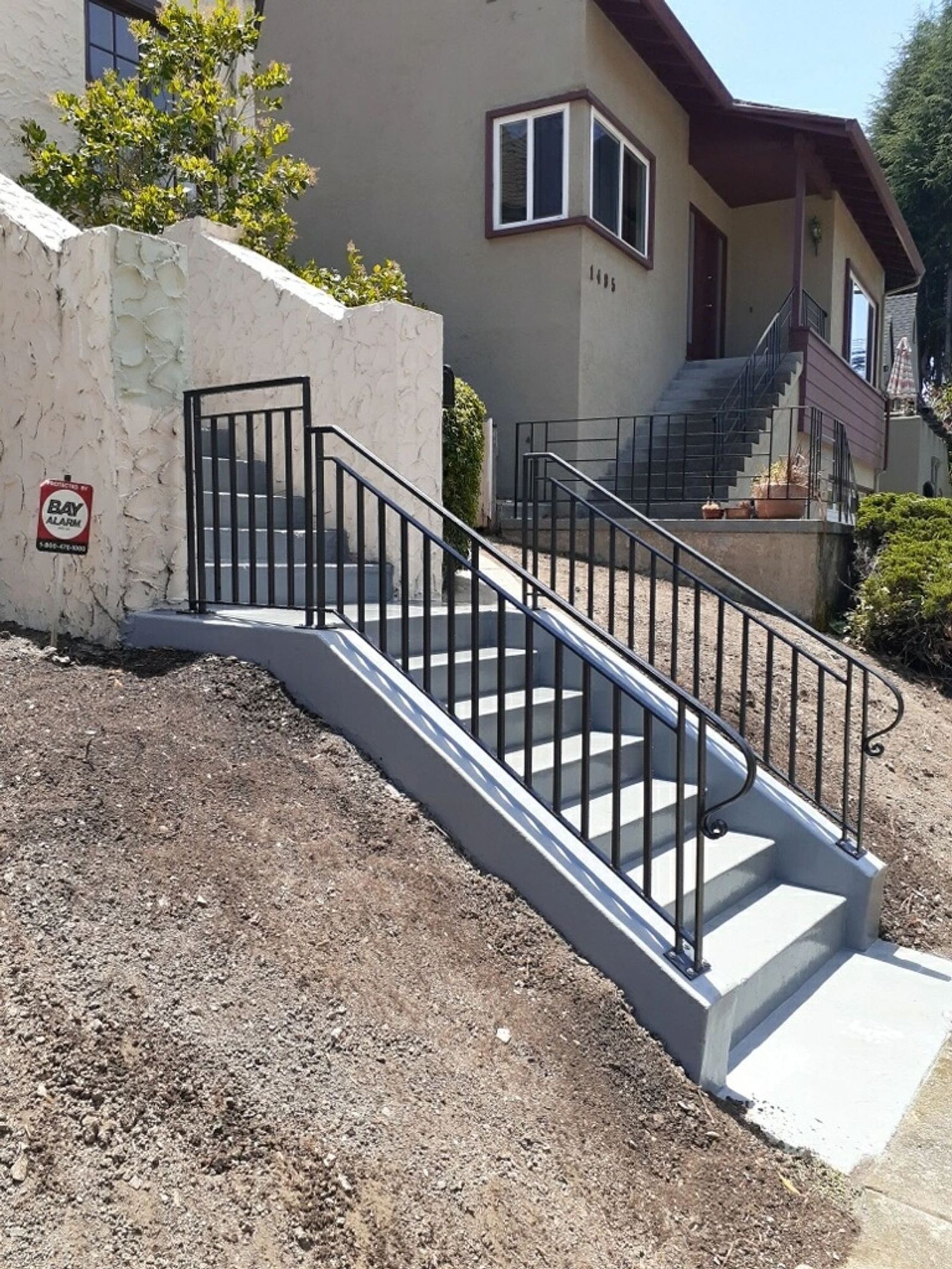
- Measured
- On the stringerNever from a nominal rise/run.
- Where
- Inside & outFinish matched to exposure.
- Estimate
- FreePhoto of the flight to start.
- Coverage
- Serving the East BayHayward and the East Bay.
What we build
Interior stair railings on open and closed staircases, exterior stair rails on concrete steps and timber stairs, landing guards that carry through from the raked section, and curved runs where the stair itself curves.
Every stair rail is really two problems joined together: the raked section along the flight and the level section at the landing. Where they meet is the detail that separates a fabricated railing from a kit — the transition either flows or it kinks, and it kinks whenever the angle was assumed rather than measured.
The measurement
We measure the total rise, the total run, and the individual treads — because on an older stair they are not all the same, and the rail has to sit at a consistent height above every nosing regardless.
On a curved stair, the top rail is fabricated to the curve rather than assembled from short straight segments. A segmented curve looks like a segmented curve, and once you have seen the difference you cannot stop seeing it.
Handrail, guard, or both
A handrail is what you hold. A guard is what stops a fall off the open side. On a lot of stairs one piece of metalwork has to be both, and the two jobs have different rules — the handrail has a graspability requirement and a height band measured off the nosing; the guard has a taller minimum height and an infill spacing limit.
Getting this wrong is the single most common failure on a stair railing, and it is almost always in the same direction: something built to look right that does not meet the guard rule. We design against the rule first.
Building code, stated plainly
Guards on stairs, landings and elevated walking surfaces are governed by the code your city has adopted — commonly a guard height in the 36″–42″ range and infill spacing that stops a 4″ sphere passing through, with a graspable handrail profile within a specified height band above the nosings. The exact numbers depend on the code cycle and the jurisdiction.
We build to what applies to your job and can tell you what to ask. For anything that needs a permit, confirm the specifics with your city’s building department before fabrication — they have the final word, not us.
Style, and what it costs
A plain vertical-picket rail is the most economical and, on a lot of stairs, the right answer. Patterned infill, shaped balusters, decorative collars, geometric panels and horizontal-bar designs all cost more, mostly in fabrication hours rather than material.
Horizontal designs have one extra consideration on a stair with children: closely spaced horizontals can be climbable, which some jurisdictions treat as a guard problem. Worth raising before you fall in love with the look.
Interior vs. exterior
Interior rails are the simpler job — no weather, more freedom on finish, and the mounting points are into framing you can find.
Exterior stair rails have to survive rain, sun and temperature cycling without the welds or the anchor points failing years later. On concrete steps, core-drilling and grouting the posts in is stronger than surface-mounting to a base plate, and it is what we do unless the slab makes it impossible.
How the estimate works
Text (510) 363-2490 a photo taken from the bottom of the flight looking up, and one from the side if you can get it. Tell us how many steps and whether one side or both need a rail. That is enough for a real range; the exact number comes off the on-site measurement.
Projects
Stair Railings we’ve built.
Photographed on completed jobs. Measurements and pricing come at the estimate, on your own opening.
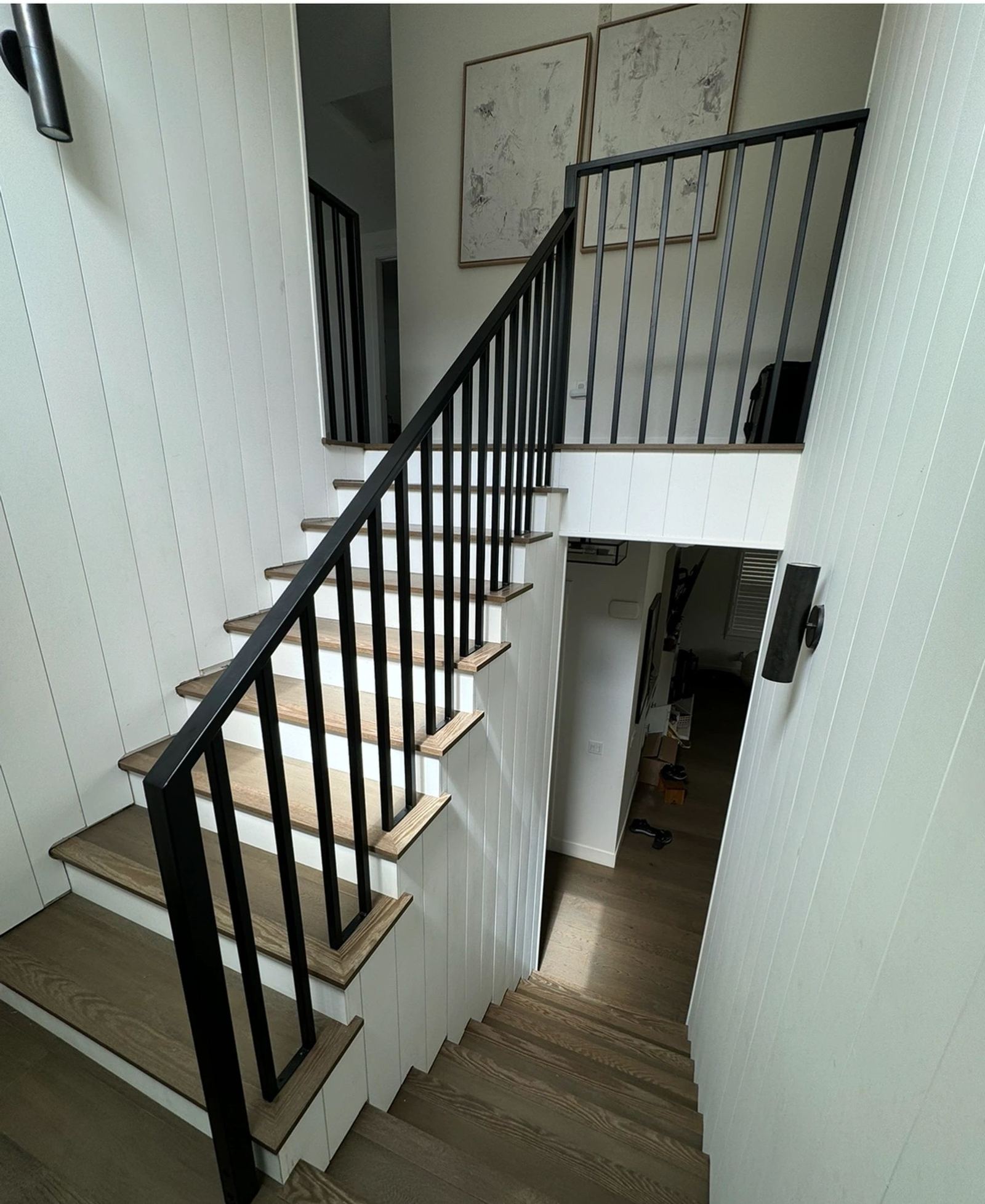
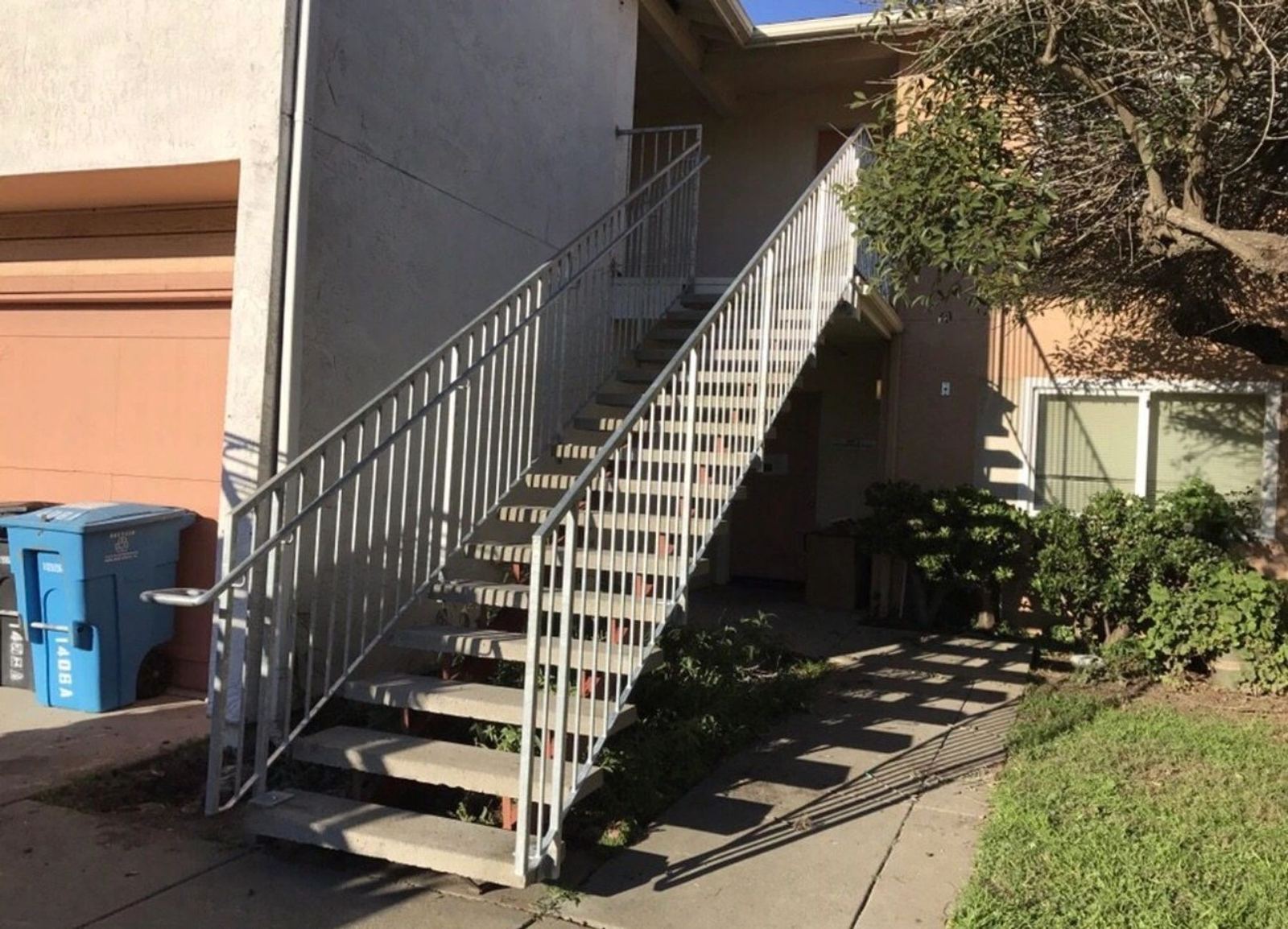
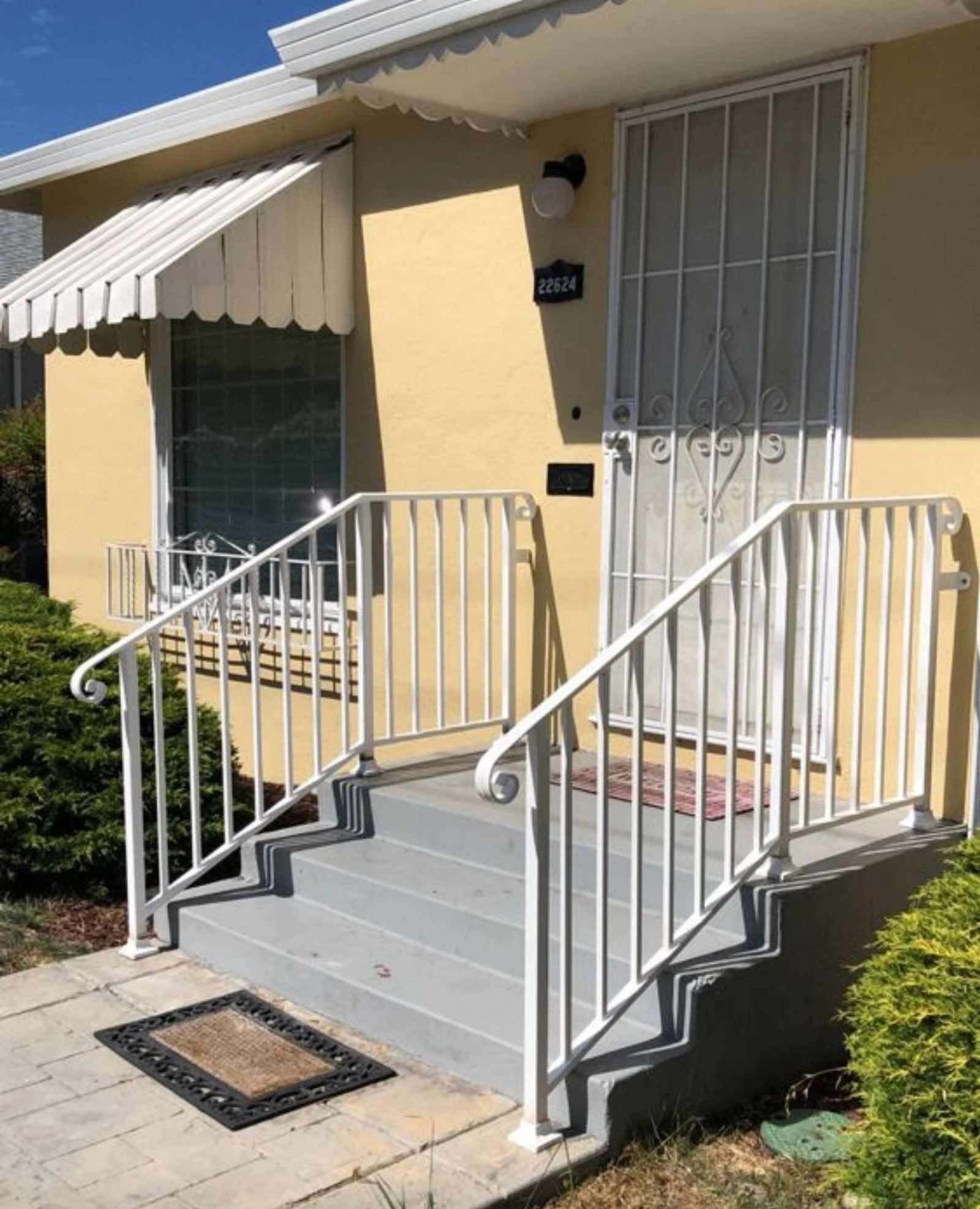
Stair Railings
What people ask before booking.
Why can a stair railing not be measured from a photo?
Because the rake angle has to be exact. A stair railing runs parallel to a line drawn across the tread nosings, and that angle is set by the actual rise and run of the stair you have — not the nominal one. Real stairs, especially older ones, vary tread to tread. Get the angle wrong by a degree over a long flight and the rail arrives at the landing at the wrong height. We measure on the stringer.
What height does a stair rail have to be?
Handrail height on a stair is measured vertically from the tread nosing, and the range your city allows is set by the code cycle it has adopted — commonly a band in the mid-thirties of inches, but the exact numbers differ by jurisdiction and by whether the rail is also serving as a guard. Guards on an open side of a stair have their own, taller requirement and their own infill spacing rule. We build to what applies to your job and can tell you what that means for your stair; for anything permitted, your building department has the final word.
Can you match the railing on the other half of my staircase?
Usually. Send a straight-on photo of the existing section and a close-up of one baluster and the top rail profile. If the original was fabricated, we can generally match it. If it was a manufactured part, we will tell you whether that part is still made — and if it is not, we will show you the closest custom equivalent rather than promise an exact match and deliver an approximation.
Wood cap rail on a metal frame — can you do that?
Yes, and it is a good combination: the steel does the structural work, the wood is what your hand actually touches. We fabricate the frame with the mounting for the cap and coordinate on who supplies and finishes the timber. Worth deciding early, because the frame geometry changes depending on whether a cap sits on top of it or not.
Free estimate
Send a photo up the flight.
Tell us how many steps and whether one side or both need a rail — we'll give you a real range and book the measurement.
Licensed, bonded and insured — CSLB #1037852. Free estimates, no obligation.
Based in Hayward. Serving the East Bay. Not sure if it’s something we do? See the full list of services, or book a consultation.