Wall railings
Handrails anchored into what is actually behind the wall.
Wall-mounted rails for stairs, hallways, entries and ramps — brackets landed in framing or masonry, ends returned, and clearance checked against the trim they run past.
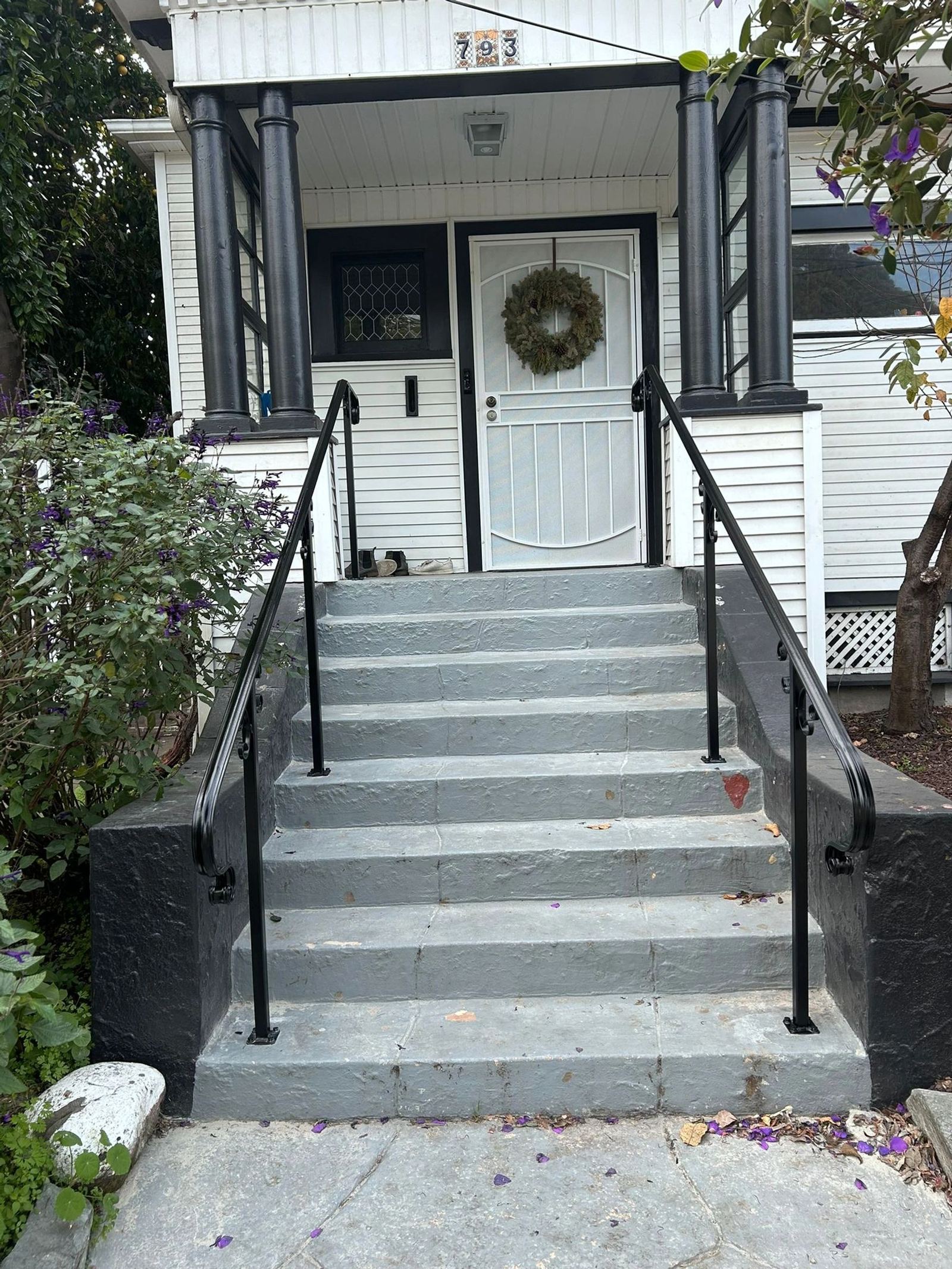
- Anchoring
- Into structureFraming, masonry or added blocking.
- Ends
- ReturnedNothing left open to catch on.
- Estimate
- FreePhoto of the wall and the run.
- Coverage
- Serving the East BayHayward and the East Bay.
What we build
Continuous wall-mounted handrails down a staircase, along a hallway, beside an entry step, or the length of a ramp. Single rails, rails on both sides of a stair or stairwell, and rails that continue around a landing without a break.
This is the least visible metalwork we do and the one where the failure mode is the most direct: a rail that lets go while someone is holding it. Everything about how it is specified follows from that.
The wall is the design problem
A wall-mounted rail transfers everything into the wall, so the wall — not the rail — sets the design. Timber-framed walls mean brackets landing on studs, which means bracket positions are dictated by framing at 16 or 24 inches rather than by where they would look best. Masonry and concrete give freedom on position but need the right anchor for the substrate. Hollow block is its own case.
Where the framing and the required bracket spacing genuinely do not line up, the options are blocking added behind the finish, a continuous mounting plate that spans studs, or accepting more brackets than the minimum. We will lay out which one applies to your wall before quoting, not after.
- What is behind the finish, established before the quote.
- Bracket spacing set by the load case, then reconciled with the framing.
- Anchors matched to the substrate — stud, masonry, block or concrete.
- Escutcheons sized to cover the probe holes finding the framing needed.
Profile, grip and continuity
A handrail has to be graspable, which in practice means a profile a hand closes around rather than one that is merely present — round or oval sections do this naturally, and a wide flat bar does not, which is why a decorative flat top rail is often paired with a proper graspable rail rather than replacing it.
Continuity is the other half. A rail that stops before the bottom step, or breaks at every landing, stops being useful exactly where people need it most. We run it through.
Height, clearance and grip are code items
Handrail mounting height above stair nosings, minimum clearance between rail and wall, graspable profile dimensions, and whether the ends must return are all set by the code cycle your city has adopted. The numbers differ by jurisdiction.
We build to what applies and will tell you what to ask. For permitted work, confirm the specifics with your building department before fabrication.
Accessibility and ageing in place
A large share of this work is someone making a home workable for a parent, a partner, or themselves. That changes the brief: rail height gets set for the person using it, the run gets extended past the top and bottom of the stair so there is something to hold before the first step and after the last, and the finish gets chosen for grip in a cold hallway rather than for looks alone.
If that is the job, say so. It leads to a different and better railing than "a handrail for the stairs" does.
How the estimate works
Text (510) 363-2490 a photo of the wall the rail is going on, plus the run — how far, and whether it is level, raked, or both. Tell us what the wall is made of if you know. Most wall rails can be quoted from that, with the framing confirmed on site before fabrication.
Projects
Wall Railings we’ve built.
Photographed on completed jobs. Measurements and pricing come at the estimate, on your own opening.
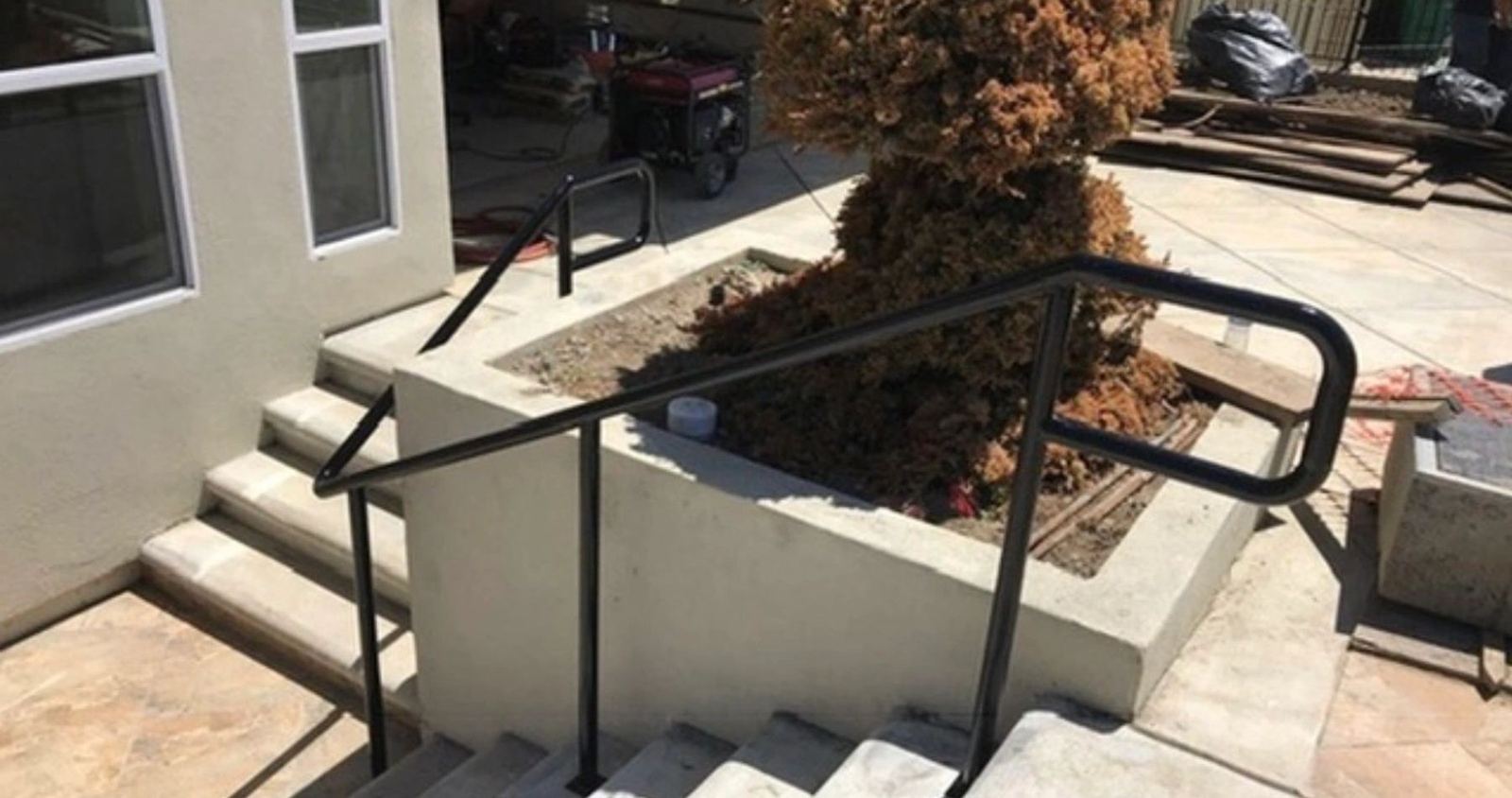
Wall Railings
What people ask before booking.
Will it hold if it is only screwed to drywall?
No, and this is the whole job. Drywall holds nothing. A wall-mounted handrail has to be anchored into framing, into masonry, or into blocking added behind the finish — and the loads a handrail is designed for are much higher than people assume, because the case that matters is someone falling onto it, not someone resting a hand on it. Before we quote, we find out what is behind the wall. If there is no structure where the brackets need to land, the honest answer is that either blocking gets added or the bracket spacing changes.
Can you find the framing without opening up my wall?
Usually. A stud finder plus a few careful probe holes in spots that will be covered by the bracket escutcheons gets us there most of the time. Where a bracket has to land in a place with nothing behind it, we will say so rather than sink a fastener into nothing and call it done.
What is a return, and why does it matter?
A return is where the end of the handrail turns back to the wall instead of stopping in mid-air. It matters for two reasons: an open rail end is a hook that catches a sleeve, a bag strap or a pocket, and codes commonly require handrail ends to return or terminate at a post. We return them as standard. It is a small detail that is disproportionately the difference between a handrail that feels finished and one that does not.
How far does it stand off the wall?
Enough for a hand to wrap the rail without knuckles hitting the plaster — codes set a minimum clearance for exactly that reason. Bracket projection also has to clear any skirting, dado or wall trim the rail runs past. We check the trim profile before ordering brackets, because a bracket that is 6mm too short is a bracket that gets replaced.
Free estimate
Send a photo of the wall.
Tell us the run and what the wall is made of. We'll tell you what it takes to anchor a rail into it properly.
Licensed, bonded and insured — CSLB #1037852. Free estimates, no obligation.
Based in Hayward. Serving the East Bay. Not sure if it’s something we do? See the full list of services, or book a consultation.