Grab railings
The rail someone actually reaches for.
Short assist rails at entries, single steps and level changes — placed for the person using them, anchored into real structure, and finished with returns so nothing catches.
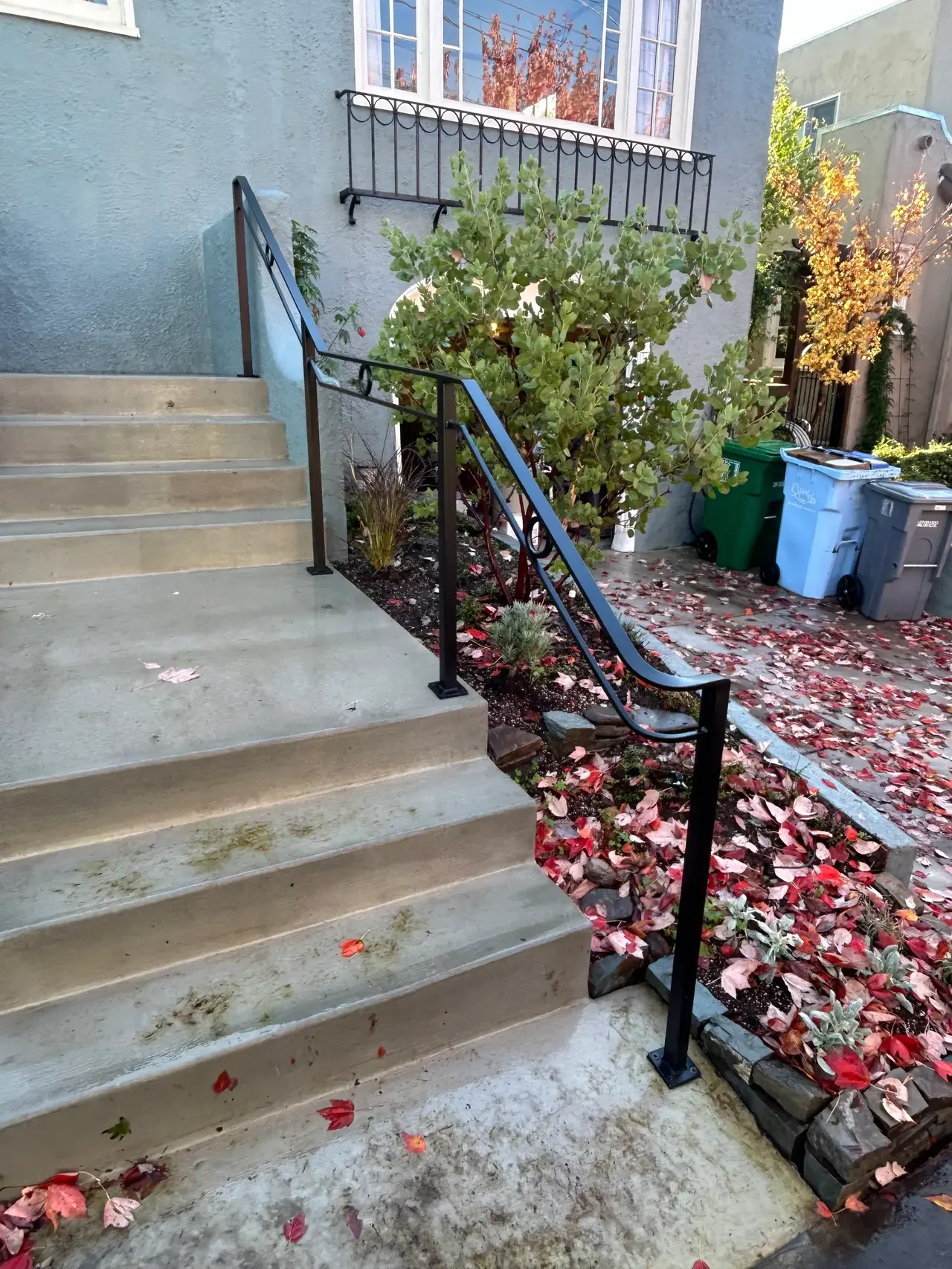
Reference photo of the category, not an ATR job — ATR photos of this specific work are being collected. Everything else on this page describes how ATR builds it.
- Placed
- For the personHeight and reach set on site.
- Anchoring
- Into structureConcrete, masonry or framing.
- Estimate
- FreePhoto of the step, ideally with a hand in it.
- Coverage
- Serving the East BayHayward and the East Bay.
What we build
Short rails beside a front door, at a single step where a full handrail would look absurd, at the transition from a path to a porch, alongside a garage step, and at the top or bottom of a run where the main handrail stops just short of where a hand is still needed.
Curled-return rails, straight verticals, angled reach rails and rails that follow a couple of steps and then return to the wall. All short, all carrying their whole load at one point.
Placement beats specification
A structurally perfect grab rail in the wrong place does not get used. This is the one category of railing where the fitting decision is more important than the fabrication decision, and it cannot be made from a drawing.
The method is simple: whoever needs the rail stands where they use it and reaches. That is the height, that is the angle, that is where it goes. It is often lower than a code handrail height, sometimes at a diagonal, and occasionally on the side of the door nobody would have guessed.
- Set to the reach of the person who needs it, not to a default height.
- Angled where an angle is what the hand naturally wants.
- Clear of the door swing, the screen door and the mail slot.
- Both ends returned — no open end to catch a sleeve or a strap.
The anchorage
A grab rail is loaded in the one direction that pulls hardest on its fixings: outward and down, suddenly, with someone's full weight behind it. Two brackets, one point of contact, no help from a long run to spread the load.
So the substrate gets established first. Sound concrete or solid masonry takes a proper mechanical or chemical anchor and is the best case. Timber framing needs the bracket landing on a stud or on added blocking. Stucco, siding and drywall are finishes — they hold nothing, and a rail fixed only to them will come away.
If it is going where somebody has already fallen
Say so. A rail installed after a fall is a different brief — the placement gets set against exactly what went wrong, and it is worth also looking at whether the step itself, its lighting, or its surface is the real problem. A grab rail on a badly-lit uneven step is a partial fix, and we would rather tell you that than fit the rail and leave.
Grip in real conditions
A grab rail is used with cold hands, wet hands, and gloves. Finish matters more than on decorative work: a smooth, slick coating on an exterior rail is worse than a slightly textured one, and a section too fat to close a hand around gives no grip at all no matter how strong it is.
We spec a diameter a hand can actually close on, and a finish that keeps some bite when it is wet.
How the estimate works
Text (510) 363-2490 a photo of the step or doorway. If you can, have whoever needs the rail stand in the shot with their hand where they would want it — that single photo answers more than a paragraph of description, and it usually means we can quote without a visit.
Projects
Grab Railings we’ve built.
Photographed on completed jobs. Measurements and pricing come at the estimate, on your own opening.
Grab Railings
What people ask before booking.
What is the difference between a grab rail and a handrail?
A handrail runs the length of a stair or ramp and you slide your hand along it. A grab rail is short and fixed — you take hold of it at one point, usually to steady yourself while stepping up, stepping down, or turning. Because the whole load lands in one place instead of being spread along a run, a grab rail's anchorage matters even more than a handrail's, and it is the part most often underbuilt.
Where should it go?
Where the person using it actually reaches. That is not always where it looks tidiest. We ask whoever needs the rail to stand at the step and show us where their hand goes, and we put it there — height, angle and reach set for them rather than to a generic dimension. If the rail is for someone who is not present, the next best thing is a photo with a hand in the frame.
Is this the same as an ADA-compliant grab bar?
Not necessarily, and it is worth being precise. ADA and California accessibility standards set specific requirements for grab bars in regulated settings — public buildings, commercial premises, certain multi-family situations — covering diameter, clearance, mounting height and tested load. A private residence generally is not held to those, and most of our grab rails are residential. If your job does have to meet a specific accessibility standard, tell us which one at the estimate so it is designed to it from the start, and confirm the requirements with the authority having jurisdiction — we build to the spec you give us, we do not certify compliance.
Can it go into a stucco wall or a concrete step?
Yes. Concrete and solid masonry are the best substrates for a grab rail — the right anchor into sound concrete is stronger than almost any timber connection. Stucco is a finish, not a structure, so the anchors have to reach whatever is behind it, and we establish what that is before quoting. A grab rail fixed to stucco alone will pull out, and it will pull out at the worst possible moment.
Free estimate
Send a photo of the step.
With a hand in the frame if you can — that tells us where the rail goes better than any measurement would.
Licensed, bonded and insured — CSLB #1037852. Free estimates, no obligation.
Based in Hayward. Serving the East Bay. Not sure if it’s something we do? See the full list of services, or book a consultation.